


In the competitive world of agricultural exports, quality and safety are not optional—they are the key to gaining access to various countries. So you’ve probably wondered whether you should continue relying on pesticides or if it’s time to incorporate a physical barrier, such as anti-virus netting.
In this article, you’ll find the analysis you need to make that decision based on real data, grounded in the standards required by the U.S., Europe, and other high-value markets. You’ll learn what sets each method apart, how it affects your export certifications, what Guatemala requires for your product to cross borders, and what strategy the most successful growers are using today to improve crop quality without sacrificing profitability.
What is the difference between pesticides and insect netting when it comes to protecting your crops?
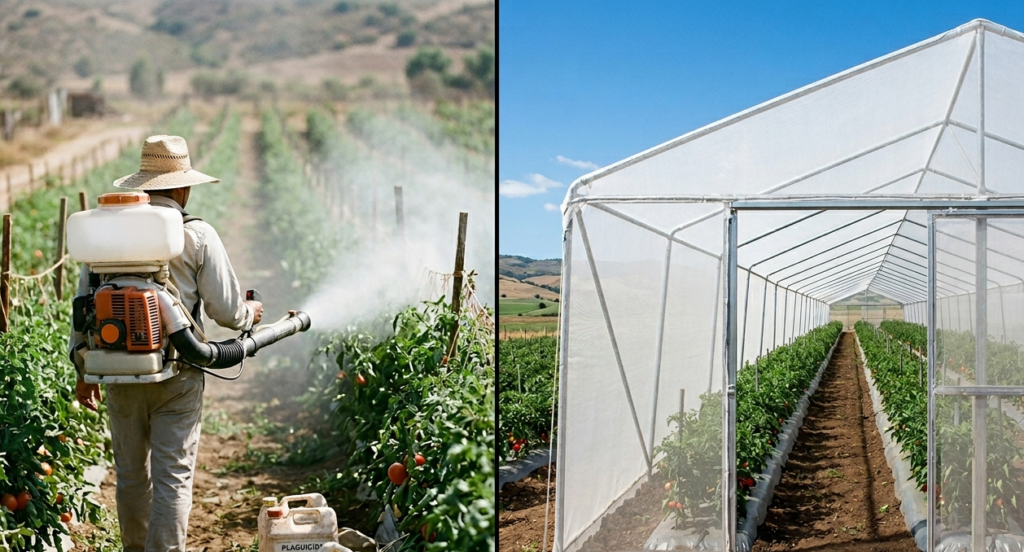
The key difference lies in when each one takes effect: pesticides are used once the pest is already present in your crop, whereas the insect-proof netting prevents it from entering in the first place. For Guatemalan export crops, this distinction completely changes your phytosanitary risk profile and your production costs.
Should I keep using pesticides, or am I putting my export crops at risk?
Pesticides help you control pests and protect your crop. In fact, without any form of control, you could lose a significant portion of your harvest before it reaches the market. The problem isn’t using them, but how you use them.
Each market has different rules regarding maximum residue limits (MRLs) in food.
For example, the FDA in the U.S. or Regulation (EC) No. 396/2005 in Europe. Keep in mind that the same product may be permitted in one country and prohibited in another, and that if your crop exceeds those limits, your shipment may be rejected, returned, or even destroyed.
Is insect netting an option for protecting crops without affecting my yield?
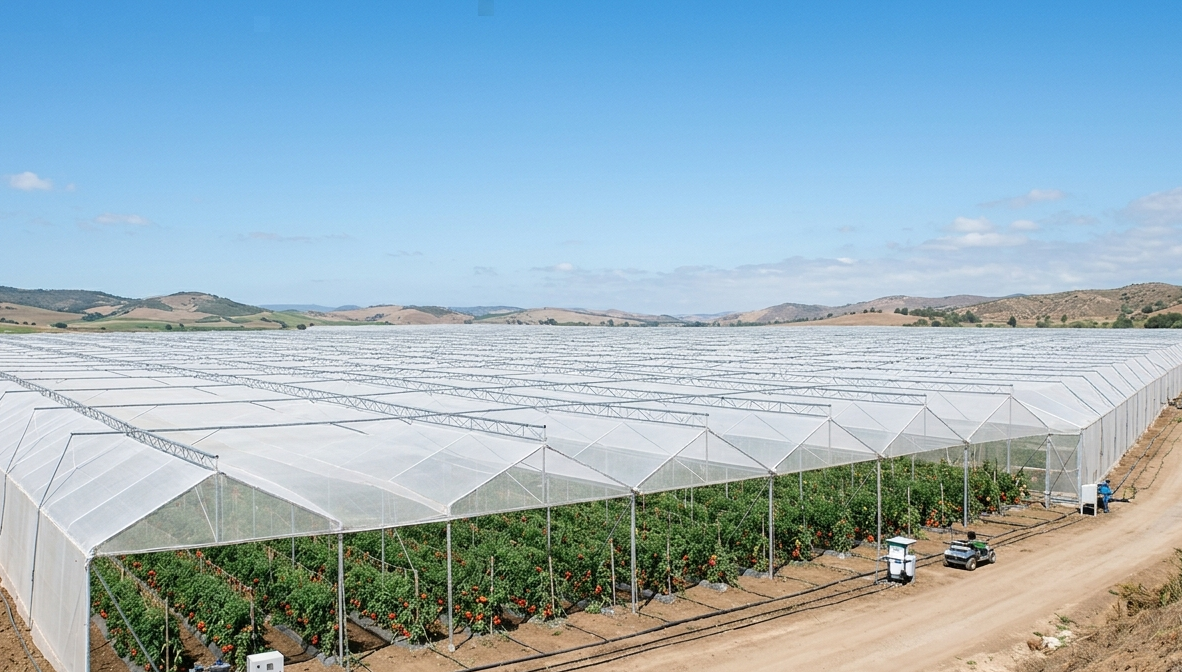
The insect-proof netting is a physical solution made of high-density polypropylene, designed to prevent the entry of insects such as thrips, whiteflies, and aphids, which often transmit diseases to crops.
Unlike pesticides, it leaves no residue on the fruit, which directly improves the safety of your produce. Additionally, by reducing pest entry from the start, it allows you to rely less on chemical applications and maintain more stable pest control within your crop.
Which is better for agricultural exports: pesticides or insect netting?
The answer isn’t to choose one over the other, but to know how to effectively combine insect netting with pesticides, using each tool at the right time to protect your crops without compromising safety.
To help you decide how to balance them within your operation, here is a comparison chart highlighting the key differences between using pesticides and insect netting:
| Specifications | Pesticides (Chemical Approach) | Antivirus Mesh (Physical Approach) |
| Mechanism | Eliminates organisms through chemical toxicity once they are already present in the crop. | A physical barrier that prevents insect vectors and microorganisms from entering from the outset. |
| Environmental Impact | Risk of soil and water source contamination when applied in excess or without following proper procedures. | A sustainable method that promotes biological control without leaving chemical residues in the environment. |
| Residues in Fruit | Requires strict monitoring of Maximum Residue Limits (MRLs) prior to each shipment. | It does not generate chemical residues, which directly improves the safety of your export product. |
| Certifications | Intensive use may make it difficult to obtain certifications such as Organic, GLOBALG.A.P., or Rainforest Alliance. | It facilitates compliance with sustainability regulations and Good Agricultural Practices (GAP). |
| Additional Benefit | Quick control of critical infestations when pests are already actively present in your crop. | Optimizes temperature, humidity, and light within the crop and can extend your growing season. |
What export certifications do you need to ship your crops out of Guatemala?
Before your product reaches a supermarket in the U.S. or Europe, it must go through a legal and technical framework coordinated by the Ministry of Agriculture, Livestock, and Food (MAGA) through the Vice Ministry of Agricultural Health and Regulations (VISAR). These are the requirements you must meet as an export producer in Guatemala:
- Phytosanitary Certificate (required for export). Issued by VISAR, this certifies that your product is free of quarantine pests. Without this document, your shipment cannot leave the country.
- Compliance with Maximum Residue Limits (MRLs) in your crops. You are required to demonstrate that your products do not exceed the pesticide residue limits of the destination country. To do this, you need chromatography analyses to detect trace levels prior to shipment.
- Sustainability certifications for premium markets. If you want to access specialized markets, you need certifications such as GLOBALG.A.P. (sustainable agriculture and responsible use of inputs), Organic certification (NOP/USDA), or Rainforest Alliance.
- Good Agricultural Practices (GAP). These form the basis of any export certification. They include monitoring the quality of irrigation water, staff hygiene, the traceability of inputs, and the proper application of pesticides.
How can you reduce pesticide use without jeopardizing your export crops?
It is possible to reduce pesticide use without leaving your crops unprotected. In fact, many growers are already doing this by implementing Integrated Crop Management (ICM), a strategy that combines physical, biological, and chemical solutions to use only what is necessary, at the right time.
- Step 1: Install insect netting as your first line of defense
By preventing insects from entering in the first place, you significantly reduce the risk of pests within your crop. This translates to fewer pesticide applications and a lower likelihood of exceeding the permitted residue limits in your final product. - Step 2: Monitor and apply only when necessary
With the netting installed, you can move away from scheduled applications. Instead, you act only when there is a real risk. This improves safety and also helps you spend less on inputs in each cycle. - Step 3: Take advantage of biological control within the crop
In a protected environment, you can use natural solutions such as beneficial insects (for example, Encarsia to control whiteflies). Because they are inside the netting, these organisms work more effectively and do not disperse, something that is difficult to achieve in open fields. - Step 4: Use pesticides only when necessary
If you need to apply chemicals, you can opt for lower-impact alternatives such as biopesticides or natural extracts. This allows you to maintain control without compromising safety or your access to export markets.
Where can I find insect-proof netting for crops in Guatemala?
If you’re considering using insect-proof netting on your crops, it’s important to work with a specialized supplier that guarantees high-quality materials and provides the right support during installation.
In Guatemala, you can purchase insect-proof netting from us, Specialty Textile Industries. We are a company specializing in agricultural textile solutions, focused on protecting your crops through efficient physical barriers against insects.
Our nets are designed to prevent the entry of pests such as whiteflies, thrips, and aphids, without affecting ventilation or internal crop conditions, helping you maintain a more controlled environment from the start.
Get answers to your questions about caring for crops intended for export from Guatemala
Is a phytosanitary certificate required to export from Guatemala?
Yes, it is mandatory. The MAGA, through VISAR, requires this document to ensure that your product complies with international technical standards and does not spread quarantine pests in the destination country. Without it, your shipment cannot be cleared through customs. You can start the application at https://www.maga.gob.gt/sitios/visar/.
What happens if my crop exceeds pesticide residue limits at customs?
Your product may be subjected to fumigation (if the destination allows it), returned to Guatemala, or destroyed directly at customs. This means direct financial losses, additional logistics costs, and most seriously, the risk that the international buyer will cancel your contract or suspend you as a supplier.
Who oversees pesticide control for your export crops in Guatemala?
In Guatemala, pesticide control is overseen by the Vice Ministry of Agricultural Health and Regulations (VISAR). Through the Comprehensive Agricultural and Environmental Protection Program (PIPAA), it is responsible for verifying that you comply with the permitted residue levels in your products.