


September and October: The Critical Time for Corn, Beans, and Year-End Inputs
If you have a farm in Guatemala, El Salvador, or Honduras, you know that the real work begins between September and October. That’s when the first harvest of corn and beans is ready to be picked, and at the same time, you need to move fertilizers, seeds, and other inputs to prepare for the post-harvest or year-end cycle.
This period presents unique operational challenges: rains are still frequent, dirt roads become slippery, and the pressure to harvest and transport quickly is high. Many farmers lose time, money, and produce due to inefficient loading and transportation methods. Furthermore, accidents involving workers moving heavy loads in the rain or on unstable terrain are more common than people realize.
The solution isn’t to work harder, but to work smarter. The industrial use of polypropylene jumbo bags to handle fertilizers, seeds, and harvested grains dramatically improves operational efficiency and protects the safety of your workers under the most challenging conditions of the year’s second growing season.
The September–October Operational Challenge
Weather and Terrain Conditions
Between September and October, the Northern Triangle still experiences frequent rains that complicate field operations:
| Condition | Impact on Operations |
| Intermittent rain | Dirt roads become slippery, hindering the movement of vehicles and people |
| Saturated soil | Vehicles get stuck, workers slip, and the risk of accidents increases |
| High humidity (80–95%) | Grain absorbs moisture; traditional bags get wet and become heavier |
| Reduced visibility | Cloudy days and rain make safe operations difficult |
Inefficient Traditional Methods
Many farmers still use 50-60 kg bags (small jute or polypropylene bags) to transport grain and fertilizer. This method presents problems such as:
- More trips
- More labor
- Higher risk of accidents
- More time
- Greater exposure to rain
The Solution: Polypropylene Jumbo Bags for Operational Efficiency
What Are Jumbo Bags, and Why Are They Ideal for Staple Grains?
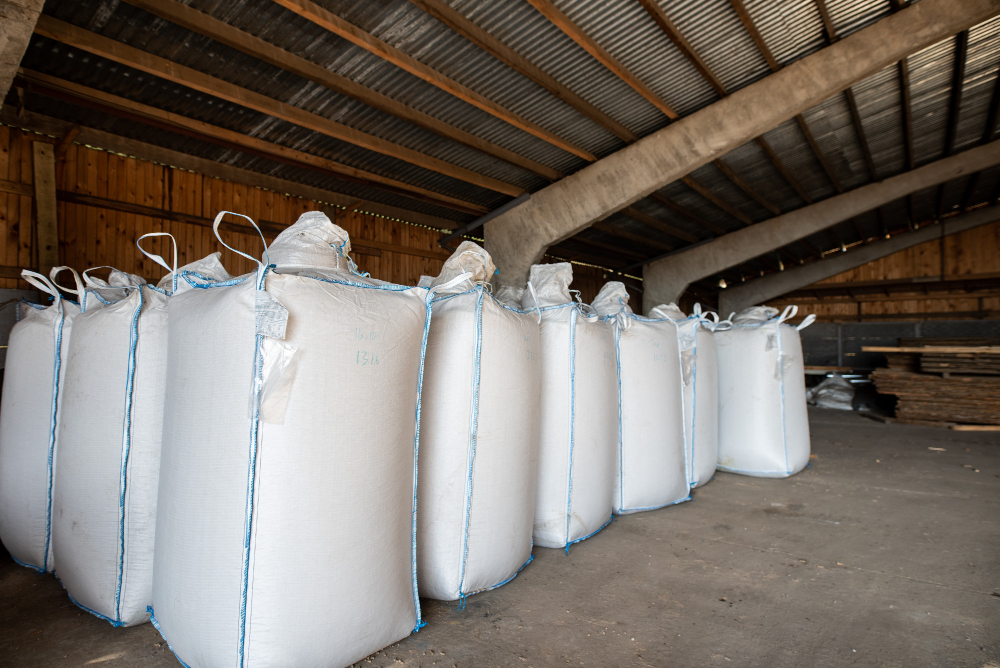
Jumbo bags are large-capacity, flexible containers designed for the transport and storage of bulk products. Made from woven high-density polypropylene, they offer a capacity of 500–2,000 kg per unit, depending on the model.
For staple grains such as corn and beans, 1,000–1,500 kg jumbo bags are the most common. For fertilizers and seeds, 500–1,000 kg bags are used.
Operational Advantages of Jumbo Bags vs. Small Bags
| Factor | Small Bags (50 kg) | Jumbo Bags (1,000 kg) | Improvement |
| Number of units per metric ton | 20 bags | 1 bag | 95% fewer units |
| Workers required | 2–3 per trip | 1–2 (with forklift) | 50–60% less labor |
| Loading/unloading time | 6–8 hours per 10 metric tons | 2–3 hours per 10 metric tons | 60–65% faster |
| Exposure to rain | 6–8 hours in the rain | 2–3 hours in the rain | 60% less exposure |
| Risk of accidents | High (repetitive manual loading) | Low (mechanized) | 70–80% less risk |
| Vehicle space utilization | 85% utilized | 95% utilized | 10% more capacity |
| Loss due to spillage | 3–5% of the product | 0.5–1% of the product | 70–80% less loss |
How Jumbo Bags Improve Safety
The use of jumbo bags radically transforms operational safety because:
- Less manual handling
- Less time spent in the rain
- Stability on slippery ground
- Better visibility and organization
Best Practices for Implementing Jumbo Bags on Your Farm
- Invest in mechanical handling equipment.
- Train operators in safe handling
- Plan transportation logistics
- Ensure proper on-farm storage
- Jumbo Bags Designed for Central America
September and October don’t have to mean long days in the rain, injured workers, and losses due to inefficiency. With polypropylene jumbo bags and proper mechanical handling, you can:
- Reduce the time required to load and transport grain and fertilizer by 60–75%
- Reduce the labor required for these operations by 70–85%
- Ensure the safety of your workers by eliminating repetitive manual lifting on slippery ground
- Minimize losses from spillage or broken bags by 80–85%
- Complete operations before the heaviest storms arrive
The investment in jumbo bags and handling equipment pays for itself in 2–3 harvests through savings in labor, time, and product recovery.
Polyproductos de Guatemala is ready to be your partner this harvest season. Our polypropylene jumbo bags, manufactured locally with a deep understanding of the conditions in the Northern Triangle, offer you the durability, capacity, and competitive pricing you need to operate efficiently in the rain and on difficult terrain.
Don’t wait for the first September storm to hit. Start using jumbo bags today, train your workers, and ensure an efficient and safe harvest for corn, beans, and year-end crops.
Frequently Asked Questions (FAQ)
Do I absolutely need a forklift to use jumbo bags?
Ideally, yes. Jumbo bags weighing 1,000–1,500 kg are designed for mechanical handling. If you don’t have a forklift, you can use a small crane or hoist in a fixed storage area. What you should not do is try to move full jumbo bags manually.
Are jumbo bags more expensive than small bags?
The cost per jumbo bag is higher, but the cost per metric ton handled is 30–40% lower.
Can I reuse jumbo bags?
Yes. Polyproductos’ polypropylene jumbo bags are designed for 2–5 uses, depending on how well they’re cared for. If you store them properly (in a dry, covered area on pallets) and handle them with a forklift (rather than dragging them), you can use them for several harvests.
What happens if it rains while loading with jumbo bags?
Polypropylene jumbo bags withstand rain well. The material does not absorb water and protects the contents. However, it is always recommended to use tarps to cover them, whether during transport or storage, and not to leave them exposed to the sun.
How long does it take to load 10 metric tons using jumbo bags?
With 1 forklift and 2 workers: 2–3 hours to load 10 metric tons (10 bags of 1,000 kg). With 50-kg bags and 4–5 workers: 6–8 hours for the same amount. This represents a time savings of 60–65%.