


The Geography of the Northern Triangle: A Magnet for Pests and Unpredictable Weather
If you’re a farmer in Guatemala, El Salvador, or Honduras, you know the reality all too well: our region’s geography is a perfect magnet for pests and unpredictable weather that can affect—or even completely destroy—your crop yields. We’re in the heart of Central America, with coastlines on both the Caribbean and the Pacific, mountains over 3,000 meters high, and humid tropical valleys. This geographic diversity creates the perfect conditions for all kinds of insects to thrive: mosquitoes, whiteflies, aphids, thrips, and leaf miners.
Between August and October, the situation becomes critical. This marks the transition from the intense rainy season to the start of the dry season, but that transition is not smooth—it is chaotic. One day it rains torrentially, the next there is bright sunshine, and the day after that it rains again. This climatic variability stresses the plants, weakens them, and makes them more vulnerable to insect attacks. Mosquitoes and other vectors proliferate in rainwater puddles, and when they encounter plants weakened by water and heat stress, the result is devastating: viruses such as tomato mosaic, leaf curl, or bacterial wilt spread like wildfire.
Many farmers focus on controlling rain with drainage systems or controlling insects with insecticides, but they overlook the most effective solution: a physical barrier that protects against both problems at the same time. The anti-virus netting is that dual-purpose solution that protects your crop from heavy rains from August through October and, at the same time, physically blocks virus-carrying insects from entering before they can infect your plants.
The Problem: Insects and Rain That Destroy Crops
Why August–October Is the Riskiest Season
Between August and October, tomato, bell pepper, sweet chili pepper, cucumber, melon, and watermelon crops face a perfect storm of threats. Rain keeps relative humidity above 85–95%, creating the ideal environment for fungi and bacteria. At the same time, temperatures fluctuate between 22–32°C, the optimal range for insect reproduction.
The main virus vectors during this period are:
- Whitefly (Bemisia tabaci)
- Aphids (Aphis gossypii, Myzus persicae)
- Thrips (Frankliniella occidentalis)
How Rain Makes the Problem Worse
The heavy rains from August through October don’t just bring water—they bring a host of problems.
- Standing water = insect breeding grounds: Water that accumulates in furrows, puddles, or even in the axils of leaves becomes the perfect breeding ground for mosquitoes and other insects. A single 1-square-meter puddle can produce 500–1,000 mosquitoes per week.
- Weakened plants are easy targets: Stress from excess water (suffocated roots, nutrients washed out of the soil) weakens plants. A weak plant produces fewer natural defenses against insects, and insects detect this chemically. It’s like a suppressed immune system in humans: it makes you more vulnerable to infections.
- Rain disperses insects: Paradoxically, rain doesn’t eliminate insects—it disperses them. When it rains, insects fly in search of shelter, and that shelter is your crops protected under roofs or in poorly sealed greenhouses. A storm can move thousands of insects from nearby weeds to your crop in a matter of minutes.
- Fungicides and insecticides get washed away: If you rely on chemical applications, the rains from August through October are your worst enemy. You apply insecticide today, it rains tomorrow, and the product gets washed away. You have to reapply, which increases costs, leads to insect resistance, and leaves residues on the fruit.
The Solution: Anti-Virus Netting as a Dual Physical Barrier
What Is Anti-Virus Netting and How Does It Work?
Anti-Virus Netting is a fine mesh structure made of UV-stabilized polypropylene or high-density polyethylene. The key lies in the mesh size: the pores measure between 0.15 and 0.40 mm—small enough to physically block the entry of insect vectors such as whiteflies (2–3 mm), aphids (1–2 mm), and thrips (1–2 mm), but large enough to allow air and light to circulate.
Dual protection: against insects AND against rain
Unlike insecticides, which only kill insects, or plastic roofs, which only protect against rain, the anti-virus netting offers dual protection:
- Physical barrier against insects (95–98% exclusion rate)
The 0.15–0.40 mm mesh creates a physical barrier that insects cannot penetrate. Studies in Guatemala and Costa Rica show that properly installed anti-virus netting reduces the entry of whiteflies by 95–98%, aphids by 90–95%, and thrips by 85–90%. This means that out of 1,000 insects flying toward your crop, only 20–50 manage to get in. This drastic reduction breaks the cycle of reproduction and virus transmission. - Protection against heavy rain
Although the netting is permeable, the fine mesh dissipates the energy of raindrops. Instead of large, heavy raindrops striking the leaves directly (causing mechanical damage and spreading pathogens), the netting transforms the rain into a fine drizzle that plants can absorb without harm. Additionally, when installed at an angle or combined with partial canopies, the netting diverts excess water, preventing waterlogging in the root zone. - Stable Microclimate
The anti-virus net creates a more stable microclimate beneath it: it reduces wind speed by 40–60%, maintains a more constant relative humidity (preventing spikes of 95% after rain), and lowers the temperature by 3–5°C on sunny days. Plants under the net experience less stress, which makes them naturally more resistant to pests and diseases.
Why Anti-Virus Netting Is Ideal for August–October
- It works when you need it most
- It does not build up resistance
- It reduces insecticide use by 60–70%
- It protects against viruses, not just insects
Proper Installation for Maximum Protection
Installation Options Based on Crop Type and Budget
1. Full Coverage (Greenhouse or Macro-Tunnel)
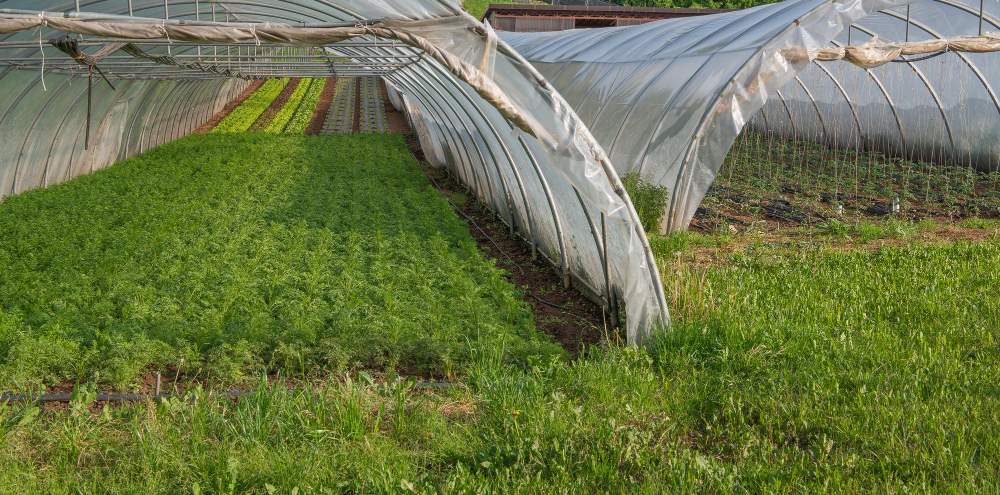
The most effective option, but also the most expensive. It involves completely covering the crop with an anti-virus cover, forming a sealed greenhouse or macro-tunnel.
Ideal for: Tomatoes, bell peppers, sweet chili peppers, and export-grade cucumbers. High-value crops where the investment is justified.
2. Side coverage (perimeter barriers)
Intermediate option: Anti-virus netting is installed only on the sides of the crop, leaving the roof open or covered with shade netting.
Ideal for: Medium-value crops, growers with limited budgets, or as a temporary measure during peak insect activity (August–October).
3. Row-Cover (Low Tunnels)
Economical option: Anti-virus netting is installed directly over the rows of plants, forming low tunnels 50–80 cm high.
Ideal for: The seedling stage and early growth (first 30–45 days), when plants are most vulnerable to viruses.
Common Mistakes That Reduce Effectiveness
- Mistake 1: Not Sealing the Edges
- Mistake 2: Poorly Designed Doors
- Mistake 3: Not Checking for Breaches
- Mistake 4: Installing Too Late
The geography of Guatemala, El Salvador, and Honduras attracts insects and creates a variable climate that can affect—or even completely destroy—your crop production. But you don’t have to accept these losses as “just the way things are.” Anti-virus netting is a proven solution that physically protects your crop from heavy rains and virus-carrying insects during the critical season from August through October.
Polyproductos de Guatemala is ready to be your partner during this rainy and insect-prone season. Our anti-virus netting, manufactured locally with a deep understanding of the conditions in the Northern Triangle, offers you the protection, durability, and competitive price you need to farm with confidence from August through October.
Don’t wait for the first sign of a virus to appear on your plants. Install anti-virus netting today, seal the edges properly, and ensure a healthy, bountiful harvest during the riskiest season of the year.
Frequently Asked Questions (FAQ)
Does the anti-virus netting block the light that plants need?
Not significantly. The 0.20–0.30 mm netting allows 85–90% of sunlight to pass through, which is sufficient for optimal photosynthesis. You’ll only notice a slight reduction (10–15%), which actually benefits the plants on days with intense sunlight by reducing heat stress.
Do I need to pollinate by hand if I use anti-virus netting?
It depends on the crop. For tomatoes, bell peppers, and sweet peppers, pollination may be slightly reduced because bees have difficulty getting through the netting. Solutions:
For self-pollinating crops like beans or rice, there’s no problem—they pollinate themselves.
Can the anti-virus netting withstand tropical storms?
Polyproductos’ polypropylene netting is designed to withstand winds of up to 80 km/h if properly installed. However, for severe tropical storms (hurricanes, winds >100 km/h), we recommend:
Can I install the netting myself, or do I need a technician?
Experienced growers can install the netting themselves by following Polyproductos’ instructions. However, for full-coverage structures (greenhouses), we recommend initial technical guidance to ensure the structure is sturdy and properly sealed. Polyproductos offers free technical guidance with purchase.
How long does the anti-virus netting last before it needs to be replaced?
Polyproductos’ UV-stabilized polypropylene/polyethylene netting lasts 3–5 years under field conditions in Guatemala, El Salvador, and Honduras. With proper maintenance (post-storm inspections, repair of small tears, and removal of debris), its lifespan can be extended to 5–6 years.