


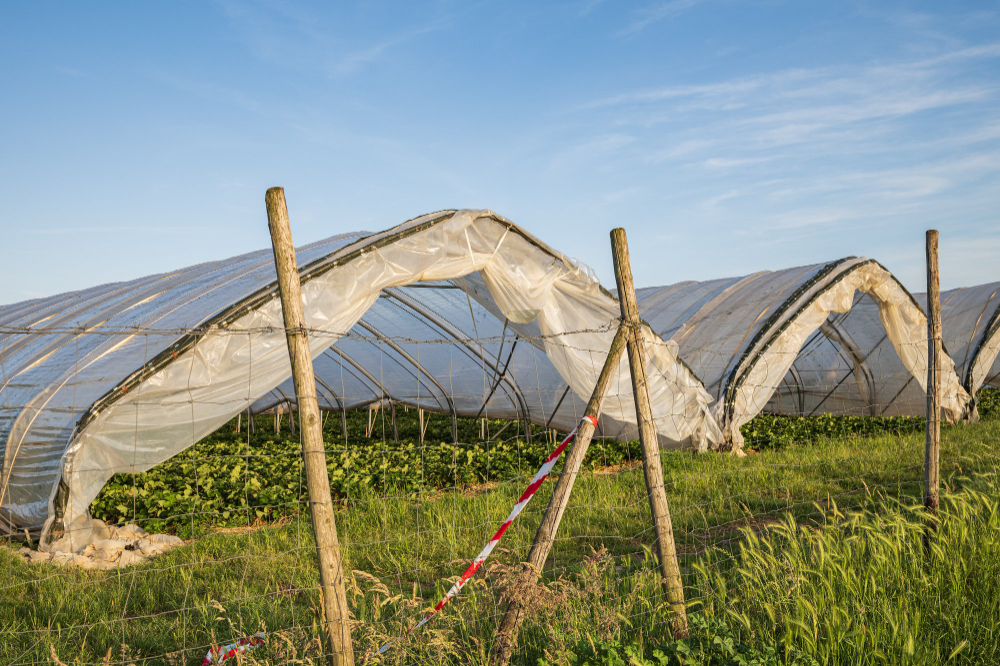
August and September: The Most Unpredictable Season for Late Plantings
If you farm in the highlands of Guatemala (Quetzaltenango, Totonicapán, Huehuetenango, Baja Verapaz) or Honduras (Comayagua, Lempira, Intibucá, La Paz), you’re well aware of the wild weather in August and September. One morning may dawn with bright sunshine that pushes temperatures up to 28–32°C, and by afternoon, a hailstorm may strike, destroying months of work in 10–15 minutes.
This sudden transition between storms and bright sunshine causes heat stress in plants. The tender shoots of tomatoes, bell peppers, sweet peppers, lettuce, broccoli, and strawberries wither from the excessive heat after the rain—or worse yet, are battered and destroyed by sudden hailstorms that strike without warning.
Late plantings (those typically planted in July for harvest in October–November) are the most vulnerable. They are in their vegetative growth stage or early flowering stage, when the tissues are most tender and sensitive. A single hailstorm can cause losses of 60–80% of expected production.
The solution is not to avoid planting during this season, but to protect crops intelligently. Agricultural polypropylene and polyethylene netting acts as a protective shield that regulates the entry of direct sunlight after storms and protects tender shoots and delicate fruits from sudden hailstorms.
The Problem: Heat Stress and Hail in High-Altitude Areas
Why August–September Is So Unpredictable
In the high-altitude areas of Guatemala and Honduras, we know that August and September mark the transition from the intense rainy season to the start of the dry season. This transition is not gradual—it is chaotic.
Mornings are usually clear, with intense solar radiation that quickly raises the temperature. Afternoons bring vertically developing clouds that unleash thunderstorms and, in some cases, hail. Hail in Central America is not like that in Europe or North America: the hailstones are small (5–20 mm), but they fall with such intensity and frequency that they can literally pierce leaves until they look like colanders, snap tender stems, and bruise fruit until it becomes unsellable.
Even when there is no hail, heat stress caused by sudden temperature changes damages plants. After a storm, the sun comes out suddenly and the temperature rises by 10–15°C in a matter of minutes. The plants, which were cool and damp from the rain, cannot regulate their temperature fast enough.
The symptoms are clear: leaves that wilt even when the soil is moist, scorched leaf edges (marginal necrosis), flowers that abort and fall off, and small or misshapen fruits. All of this results in a 20–30% reduction in yield, even without hail.
The Solution: Agricultural Nets as a Protective Shield
What are polypropylene agricultural nets?
Agricultural nets are woven or knitted structures made of polypropylene (PP) or high-density polyethylene (PE) that are UV-stabilized. They are installed over crops, forming a canopy that filters sunlight and cushions the impact of hail.
These nets come in different shading percentages (30%, 50%, 70%, 90%) that determine how much sunlight they block. For most high-altitude crops in Central America, nets with 50–70% shading are ideal.
How Shade Nets Regulate Sunlight After Storms
When the sun comes out after a storm, agricultural shade nets act as an optical filter that:
- Reduces the intensity of direct radiation: Shade nets providing 50–70% shade block that proportion of solar radiation, allowing only 30–50% to reach the plants. This prevents the foliage from overheating and reduces the temperature under the shade cloth by 4–8°C compared to full sun.
- Diffuses light: Instead of direct sunlight creating hot spots on the leaves, the shade cloth diffuses the light, distributing it evenly across the entire crop. This means that all leaves receive light for photosynthesis without getting burned.
- Maintains stable relative humidity: By reducing the temperature, the shade cloth also reduces the rate of evaporation. Plants lose less water through transpiration, staying hydrated even when the sun comes out after rain.
- Result: Plants under the shade cloth do not suffer the thermal shock of going from 20°C (after rain) to 35°C (direct sunlight) in a matter of minutes. The transition is gradual, and the plants keep their stomata open, continue to photosynthesize, and keep growing without stress.
How Netting Protects Against Hail
When hail falls, agricultural netting acts as a physical buffer that:
- Absorbs kinetic energy: Hailstones fall at speeds of 30–50 km/h. Upon impact with the netting, the energy is dissipated through the woven structure, reducing the speed and force of the impact before it reaches the plants.
- Breaks up large hailstones: Mesh netting (the most effective against hail) has the ability to break large hailstones into smaller fragments upon impact. These fragments fall with much less energy and cause no damage.
- Distributes the impact: Instead of each hailstone striking a leaf or fruit directly, the netting distributes the impact over a larger surface area, protecting the crop beneath.
August and September don’t have to be synonymous with uncertainty and losses due to hail and heat stress. With polypropylene agricultural netting, you can create a controlled microclimate that protects your late-season crops, regulates temperature, and ensures a bountiful harvest in October–November.
Polyproductos de Guatemala is ready to be your partner during this transitional season. Our shade nets and anti-hail nets, manufactured with a deep understanding of highland conditions, offer you the protection, durability, and competitive pricing you need to farm with confidence in Quetzaltenango, Huehuetenango, and the highlands of Honduras.
Frequently Asked Questions (FAQ)
What percentage of shade do I need for my crops?
- It depends on the crop and the elevation:
- Tomatoes, bell peppers, sweet peppers (1,500–2,000 meters above sea level): 50% shade
- Lettuce, broccoli, cauliflower (2,000–2,500 meters above sea level): 70% shade
- Strawberries, ornamental flowers (2,500+ meters above sea level): 70–90% shade
For areas with frequent hail, prioritize open-mesh anti-hail netting over the shade percentage.
Does anti-hail netting also provide shade?
Yes, but less than dedicated shade netting. Mesh anti-hail netting typically provides 30–40% shade. If you need more shade, you can combine the two: install anti-hail netting first (for protection against hail) and then install 50% shade netting on top (for temperature regulation).
Does agricultural netting reduce pollination?
Slightly, but not significantly. Netting with 50–70% shade allows air and pollinating insects to pass through.
How long does agricultural netting last before it needs to be replaced?
Polyproductos’ UV-stabilized polypropylene/polyethylene netting lasts 3–5 years in high-altitude conditions (intense radiation, hail, temperature fluctuations). With proper maintenance (post-storm inspections, repair of small tears), its lifespan can be extended to 5–6 years.