


Guatemala is one of the Central American countries with a diverse agricultural industry. From the volcanic slopes of the highlands to the valleys of the east, thousands of growers like you cultivate ornamental plants, fruit trees, and specialty coffee; however, this productive wealth may be threatened by excessive moisture caused by the country’s tropical climate.
One of Guatemala’s defining characteristics is its intense rainy seasons and high humidity, which create conditions for water to pool in the soil of aisles and terraces. This waterlogging, combined with poor water management, leads to direct economic losses due to root rot, devastating fungi such as Phytophthora, and plants that lose their commercial value before reaching the customer. In this article, you will learn the most effective strategies to protect your crops from soil moisture and prevent losses in yield, quality, and plant health in your production.
Why can excess moisture in planters quickly harm your plants?
Your plants can be harmed by excessive moisture because it triggers a series of physical, chemical, and biological processes that damage their health from the roots up.
Why are my plants’ roots rotting if I’m watering them the same way I always have?
When the soil at the base of your plants retains water, the roots are deprived of oxygen and die within 24 to 72 hours, before you notice any visible symptoms in the foliage. This is called anaerobic waterlogging and is a major cause of root and stem rot in nurseries during the rainy season.
In nurseries with a high density of pots, the problem is exacerbated when water runs from one pot to another and uncovered aisles turn into muddy areas that remain saturated for hours or days after each watering or rainfall.
How do I know if the fungus on my plants is caused by wet soil?
If the fungus first appears at the base of the stem or on the roots, it comes from the soil. If it appears on the lower leaves and spreads upward, it comes from the humid air between the pots. In both cases, excess moisture is the trigger. A nursery with waterlogged aisles harbors four of the region’s most harmful fungi: Botrytis cinerea (gray mold), Fusarium spp., Pythium spp., and the most feared, Phytophthora.
- Gray mold (Botrytis cinerea): proliferates on damp foliage and plant debris accumulated between pots.
- Fusarium spp: attacks the plant’s vascular tissues, causing irreversible wilting.
- Pythium spp: destroys seeds and young seedlings in seedbeds with poor drainage.
- Phytophthora spp: the most devastating, capable of destroying entire crops in a matter of days.
How can you prevent “water mold” or Phytophthora from destroying your crop?
Of all the pathogens that threaten nurseries and greenhouses, Phytophthora also known as “water mold” is undoubtedly the most feared, as its destructive capacity makes it the leading cause of production losses in avocados, tomatoes, ornamentals, and citrus fruits throughout Central America.
Why does Phytophthora attack in conditions of excess moisture?
Phytophthora attacks when there is excess moisture and waterlogging because it needs water to move and infect plants. Phytophthora is a microorganism that travels through the water in your nursery’s soil and produces small, motile spores called zoospores, which “swim” to the roots and infect them; therefore, avoiding excess water is the most effective way to prevent this problem.
Poor hygiene in your nursery can also contribute to the spread of the disease. Decaying plant debris, such as fallen leaves, cut stems, or old potting mix, creates environments where Phytophthora and other pathogens can survive for long periods.
The problem is that when it rains or you water, the water splashes onto this debris and spreads the pathogen throughout the nursery, facilitating new infections.
Why use Ground Cover to prevent plant pathogens or diseases?
Ground Cover mesh (agricultural geotextile) acts as a physical barrier between the soil and the pots or fruits. This protective mechanism is highly effective against pathogens such as Phytophthora for two reasons:
- It eliminates direct contact: By placing the pots on the Ground Cover mesh, you prevent the plants from coming into direct contact with the damp soil, where many pathogens thrive.
- It prevents pathogen splashes: When rainwater or irrigation water falls on bare soil, it can splash soil containing spores onto the plants and their pots. Ground Cover acts as a barrier that prevents these splashes, reducing the spread of diseases such as Phytophthora.
How can you prevent Phytophthora and other pathogens through proper water management?
You can prevent Phytophthora and other pathogens by controlling excess water and keeping your greenhouse clean. By preventing waterlogging and reducing sources of infection, you lower the risk of this disease developing. To achieve this, it is important to follow these practices:
- Efficient drainage in pots and bags. Make sure all containers have holes in the bottom so water drains properly. Ground Cover helps because it allows water to drain without forming puddles under the pots.
- Regular cleaning of the nursery. Frequently remove fallen leaves, plant debris, and old potting mix. These materials can harbor pathogens and facilitate new infections.
- Use of fungicides when necessary. If you have already detected Phytophthora, you can use specific fungicides such as phosphonates or etirimoles.
- Disinfection of tools and surfaces. Regularly clean benches, tools, and irrigation systems with disinfectants, such as hypochlorite-based solutions, to prevent the spread of the pathogen.
How to Control Humidity in Your Greenhouse?
You can control humidity in your greenhouse by maintaining it at appropriate levels, avoiding overwatering, and ensuring good air circulation among the plants. This is achieved by combining natural ventilation, constant humidity monitoring, watering only when necessary, and proper spacing between crops to prevent moisture buildup and the onset of diseases.
What should the humidity level be in a greenhouse?
The ideal humidity level in a greenhouse is below 75%, according to the FAO (Food and Agriculture Organization). If this range is exceeded, the risk of fungi and diseases increases.
The most effective way to maintain this balance is to use natural ventilation, such as skylights that allow hot air to escape and fresh air to enter. This can significantly reduce humidity inside the greenhouse.
You can also use tools like hygrometers to monitor humidity levels and fans to circulate air and prevent damp areas where pathogens thrive.
How often should I water my plants to avoid waterlogging?
There’s no exact frequency. It depends on the weather, the plant, and the potting mix. The simplest way to tell is to use the “finger test”: stick your finger 3–4 cm into the soil, and if it’s still moist, don’t water it.
Key recommendations
- Water in the morning: This way, the water evaporates during the day.
- Check the drainage: A pot with poor drainage can damage the plant in 2 to 3 days.
Does placing plants too close together worsen humidity?
Yes. When they’re too close together, air doesn’t circulate and the leaves stay damp longer. This creates the perfect environment for mold to grow.
Solution:
- Leave space between plants
- Leave aisles
- Follow the recommended spacing for each species
It’s a simple change, but it greatly reduces disease.
What is Ground Cover, and how does it help you control soil moisture in your nursery?
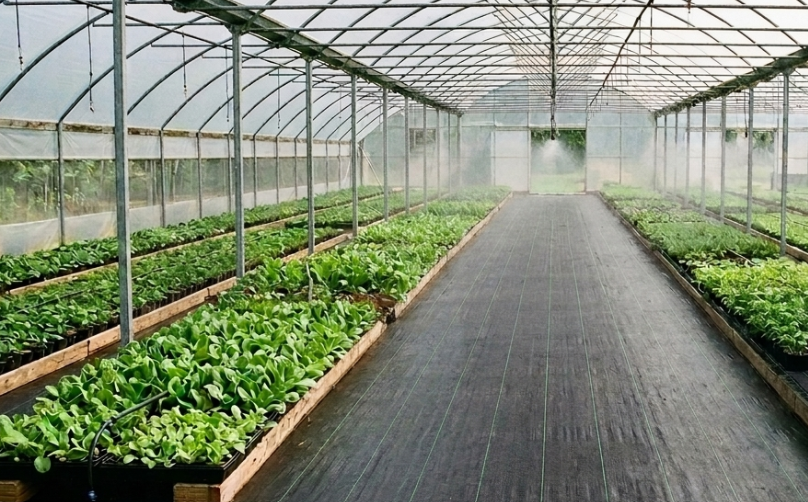
Ground Cover is a high-density polypropylene mesh that is placed on the ground in aisles and work areas, allowing water to drain without forming puddles while creating a barrier between the damp soil and the plants. This reduces moisture buildup on the floor and prevents pathogens from reaching the pots.
Its function is simple but very effective:
- It allows water to pass through, preventing puddles from forming
- It blocks sunlight from reaching the soil surface, which prevents weed growth
- It creates a clean surface, separating the soil from the pots
If I’ve already laid black nylon in the aisles, why do I still have moisture problems?
Because the plastic is impermeable, water doesn’t drain; it sits on top, forming puddles that raise humidity levels and create breeding grounds for mosquitoes and fungi. Additionally, it damages the soil beneath by depriving it of oxygen. Ground Cover solves exactly this problem: its fabric allows water to pass freely into the subsoil, eliminates puddles, and continues to block light so weeds don’t grow.
Benefits of Specialty Textile Industries’ Ground Cover in Guatemala
Specialty Textile Industries designs and manufactures its Ground Cover with the climatic and production conditions of tropical markets like Guatemala in mind. Its technical specifications directly address the challenges faced by Guatemalan growers.
How long does the Ground Cover last?
The durability of Specialty Textile Industries’ Ground Cover is over 7 years. Low-quality covers become brittle within months under Guatemala’s tropical radiation, especially at medium and low altitudes. When evaluating cost, always compare the price per year of service life, not the initial purchase price.
Comparison of Natural Vegetation Cover vs. Ground Cover Mesh
Conservation agriculture recommends using cover crops such as live plants or organic materials to protect the soil, improve its quality, and promote biodiversity. This practice, endorsed by the FAO, works very well in open-field crops.
However, in nurseries or greenhouses where there are many plants in a small space, these solutions have several limitations. In these cases, Ground Cover mesh is more practical and efficient.
| Criteria | Plant Cover / Organic Mulch | Ground Cover Mesh |
|---|---|---|
| Weed control | Variable (depends on its density) | Very high (95–99% light blockage) |
| Performance in drainage and waterlogging control | Variable (can retain water) | Excellent (permeable by design) |
| Health barrier against pathogens | Low (can serve as a reservoir) | High (clean, impermeable surface) |
| Shelf life in the nursery | 3–6 months (decomposes) | 2–5 years (Specialty Textile Industries’ Ground Cover mesh lasts over 7 years) |
| Ease of cleaning | Difficult (organic material) | Very easy (sweep or wash) |
| Contribution of organic matter to the soil | High (beneficial in the long term) | None (isolated soil) |
| Improvement of soil structure | High (roots and microorganisms) | Maintained (infiltration preserved) |
| Maintenance cost | High (frequent replacement) | Low (long durability) |
| Suitability for intensive nurseries | Low | Very high |
The choice between these two strategies is not mutually exclusive. A grower can use ground cover in the outer access aisles and at the base of trees in the field, while implementing Ground Cover inside the nursery or greenhouse, where hygiene and disease control are priorities. The important thing is to recognize that each tool has its optimal application.
Frequently Asked Questions About Humidity Control in Nurseries and Greenhouses
What happens if there is too much humidity in my nursery?
Excess humidity promotes the growth of fungi, root rot, and diseases such as Phytophthora. It also reduces oxygen levels in the growing medium, weakening the plants.
What is the best way to prevent waterlogging in a nursery?
The best approach is to combine good drainage in pots with the use of Ground Cover, which allows water to flow into the soil and prevents puddles from forming in the aisles.
Does Ground Cover really help prevent plant diseases?
Yes. By creating a barrier between the soil and the plants, it prevents contact with pathogens and reduces the spread of fungi in the nursery.
Is it better to use black nylon or Ground Cover?
Ground Cover is better because it allows water to drain. Black nylon retains water, creates puddles, and increases humidity, which promotes disease.