


In today’s agricultural landscape in Guatemala, adapting to the climate is a necessity, as the heat wave—that period of intense heat and scarce rainfall between July and August—has become longer, more severe, and less predictable, directly affecting crop development and yield.
Faced with this scenario, many growers are evaluating how best to protect their crops. Agrotextiles, such as shade cloth, virus-resistant netting, and ground cover, have become an effective alternative for reducing the impact of the climate, conserving soil moisture, and improving production stability.
In this article, you’ll learn how these solutions work, when it’s best to use them, and why more and more growers are incorporating them into their strategy for dealing with adverse weather conditions.
What is the dry spell, and how does it affect my plants?
The dry spell is a short drought that occurs in the middle of the rainy season and severely impacts your crops by causing both water and heat stress at the same time. In Guatemala, it generally occurs in mid-July and the second half of August and can last between 15 and 45 days. But be aware: its intensity varies each year due to factors like El Niño or La Niña, which can make it more severe or milder, so it never behaves the same way.
What Happens to Your Plants During a Heat Wave?
Imagine several days in a row without rain and with constant sunshine. The soil temperature rises, the environment becomes harsher, and your plants start to suffer. Here’s what happens to them internally:
- They become dehydrated: Without water, your plants’ cells lose their firmness. Tender shoots, flowers, and developing fruits are the first to be affected.
- They get sunburned: Solar radiation damages key parts of the plant, causing white or yellow spots that reduce its ability to photosynthesize.
- They close in on themselves: As a defense mechanism, the plant closes its pores, breathes less, and slows its growth. This helps it survive, but it affects production.
- They lose flowers and fruits: A few days of extreme heat during flowering can ruin weeks of work. It is one of the most sensitive stages of cultivation.
How can you protect your crops from heat and lack of rain?
One of the most practical and affordable ways to protect your crops is to use agricultural netting or agrotextiles to create a controlled microclimate. Agrotextiles act as a protective layer for your crops by filtering out excess radiation, blocking pests, retaining soil moisture, and helping to stabilize the environment around your plants. This allows you to maintain more stable conditions for temperature, light, and humidity, even in adverse climates.
One important thing to keep in mind is that agrotextiles do not replace your current practices; crop rotation, selecting resistant varieties, and efficient irrigation remain key. Agrotextiles simply reinforce your strategy and give you greater control over the outcome.
Which agrotextiles should you use during hot weather, and how do they help your plants?
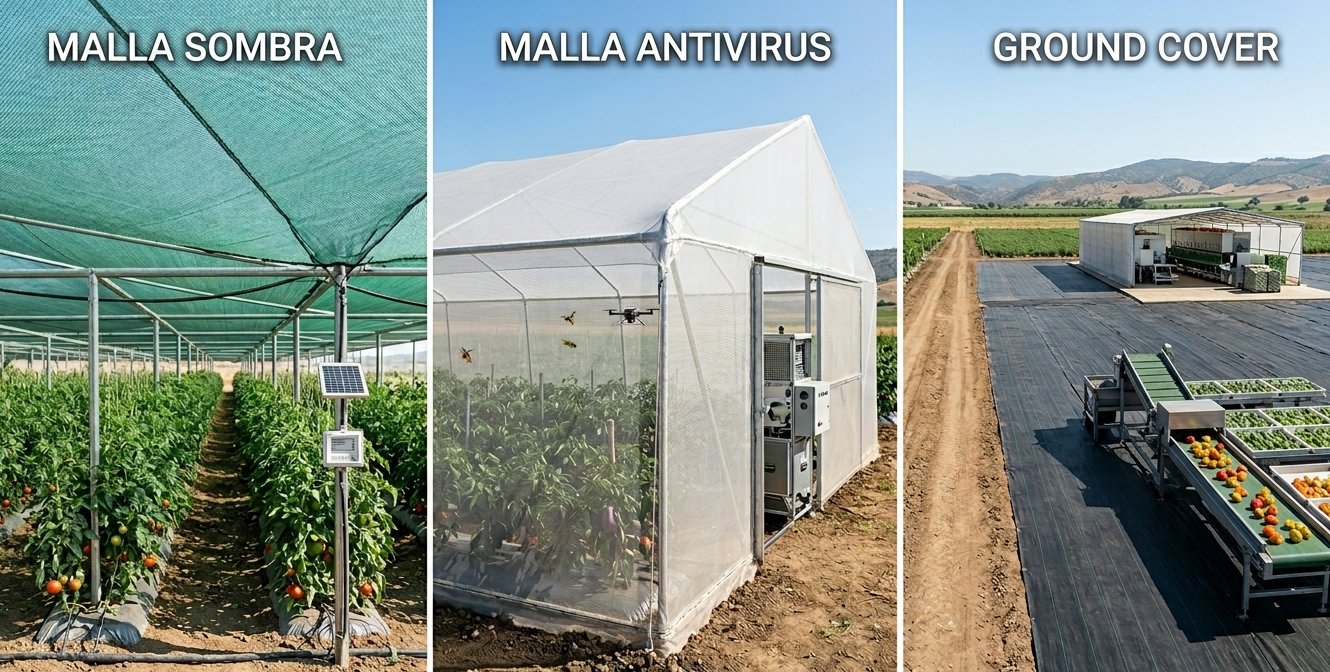
There are three types of agrotextiles useful for coping with hot weather: shade cloth, virus-resistant netting, and ground cover. Each serves a specific purpose, and together they offer more comprehensive protection.
Shade cloth for temperature and light control
Shade cloth is used to regulate the amount of sunlight your plants receive, filtering out the radiation that causes sunburn and heat stress. You can choose different levels of shade (from 10% to 95%) depending on your crop and location.
How it helps during heat waves:
By reducing solar radiation and lowering the temperature inside the grow area, it allows the plant to maintain its activity, performing photosynthesis and making better use of available water. In areas of extreme heat, it can be the difference between losing or saving the crop.
Insect-proof netting for pest protection
Insect-proof or anti virus mesh netting acts as a physical barrier that prevents insects such as whiteflies, aphids, and thrips from entering, without blocking airflow or light.
How it helps during heat waves:
Heat accelerates pest reproduction. With this netting, you protect your crops without affecting ventilation. Additionally, you reduce the need for pesticides, which lowers costs and improves the quality of your produce.
Ground cover for moisture and weed control
Ground cover is a material placed on the soil to protect it. It acts as a physical barrier that blocks weed growth while allowing water, air, and nutrients to reach the roots. It also helps retain moisture and maintain a more stable temperature at the soil surface.
How it helps during the heatwave:
It reduces evaporation by covering the soil and protecting it from direct sunlight, allowing moisture to remain available longer in the root zone. At the same time, its permeable structure allows water to pass through and promotes drainage, preventing waterlogging. It also limits weed growth by reducing competition for water and nutrients and helps maintain a more stable soil temperature in the face of extreme heat.
| Type of netting | Main function | Key benefit in terms of heat | Impact on your crop |
| Shade Cloth | Solar radiation control | Lowers the temperature inside the greenhouse | Prevents sunburn and dehydration |
| Anti Virus Mesh | Physical barrier against insect vectors | Protects you from pests during the hottest months | Drastically reduces pesticide use |
| Ground Cover | Weed control and soil care | Retains moisture when you need it most | Improves water efficiency |
These three agricultural textiles can be combined within the same production system. In fact, using shade cloth and virus-control netting in tunnels and ground cover on the ground is one of the most comprehensive protection systems available to farmers today.
Where can I find high-quality agricultural netting?
Specialty Textile Industries manufactures shade cloth, virus-control netting, and ground cover to the technical standards your crops require.
Behind every meter of fabric lies a deep understanding of what it means to wake up early to check if the plants survived the hottest night of the year, or what it’s like to lose a crop due to a lack of protection. Specialty Textile Industries doesn’t just produce agrotextiles; it develops solutions designed by and for those who work in agriculture every day, with technical specifications adapted to the levels of radiation, humidity, and pest pressure specific to Guatemala.
Everything You Need to Know to Protect Crops During a Heat Wave
When should I install agricultural shade nets to protect crops from the heat?
Ideally, you should install them before the heat wave begins. This way, your crops are already protected when the days of intense sunlight and lack of rain arrive. Waiting until stress becomes visible may be too late, as damage to flowers, leaves, or fruits is often irreversible.
What problem do the nets solve during the heatwave?
The nets help control the main effects of extreme heat, reduce solar radiation, conserve soil moisture, and decrease pest pressure. This allows the plant to maintain its normal activity, even under conditions of climatic stress.
How do shade nets help conserve water during hot weather?
By covering the soil or filtering solar radiation, they reduce evaporation and help maintain moisture in the root zone for longer. This not only protects the crop but also allows you to optimize irrigation during a period when water is more limited.
What happens if I don’t protect my crops during a heat wave?
Extreme heat and lack of water can cause dehydration, leaf scorch, flower drop, and fruit loss. In many cases, just a few days of stress during critical stages of the crop’s growth can result in significant harvest losses.